The Technology Behind Self-Provenance
Tachyon's integrated system turns the inherent surface and sub-surface physical features of any real-world object into a unique digital identity. It combines advanced imaging, physics-based 3D reconstruction, purpose-built algorithms and secure data storage. Each layer has one job:
Precise imaging captures the raw data.
The digital twin that captures and preserves the object's physical and material characteristics.
Algorithms deliver fast, reliable identification.
Scalable architecture supports billions of objects across industries.
Beyond the conventional digital twin
Most digital twins are a general object archetype: a designed or approximated shape with surface textures that look right. Tachyon's digital twin is measured from the object itself, including how its material interacts with light, so it describes this specific object rather than a model of it.
Conventional digital twin
Tachyon digital twin
Geometry
A general object archetype
Measured at micron level by photogrammetry, 3D scanning and spectral imaging
Material
Surface textures chosen to look right
Measured complex light-matter interaction properties across wavelengths
Light behaviour
Simplified shading
Fully spectroscopic ellipsometry-consistent
Materials it handles
Mostly opaque, reflective surfaces
Reflective, translucent and transmissive materials
What it represents
A type of object
One specific, real object
Because the Tachyon digital twin records physical and material compositional properties rather than how one camera sees an object, two Tachyon rigs scanning the same object produce the same result. That is what makes identification reliable across sites and over time.
Where physical reality becomes digital identity
Tachyon uses a patented system that extracts a compact, encrypted fingerprint from an object's own micro-geometry and spectral response. Because that fingerprint is both unique and persistent, it gives the object self-provenance at enterprise speed and security.
TECHNOLOGY
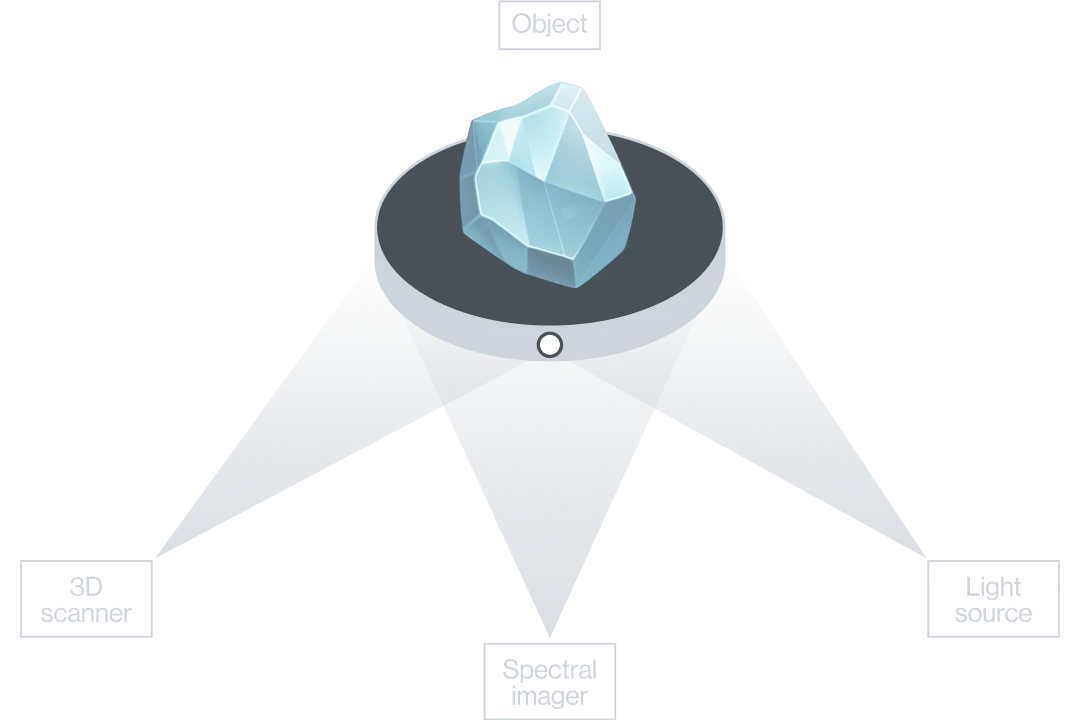
Scanning
Every object carries a unique physical signature. Tachyon's scanners capture it in several dimensions at once (geometry, spectral response and micro-imperfections), with no external markers.

Encoding
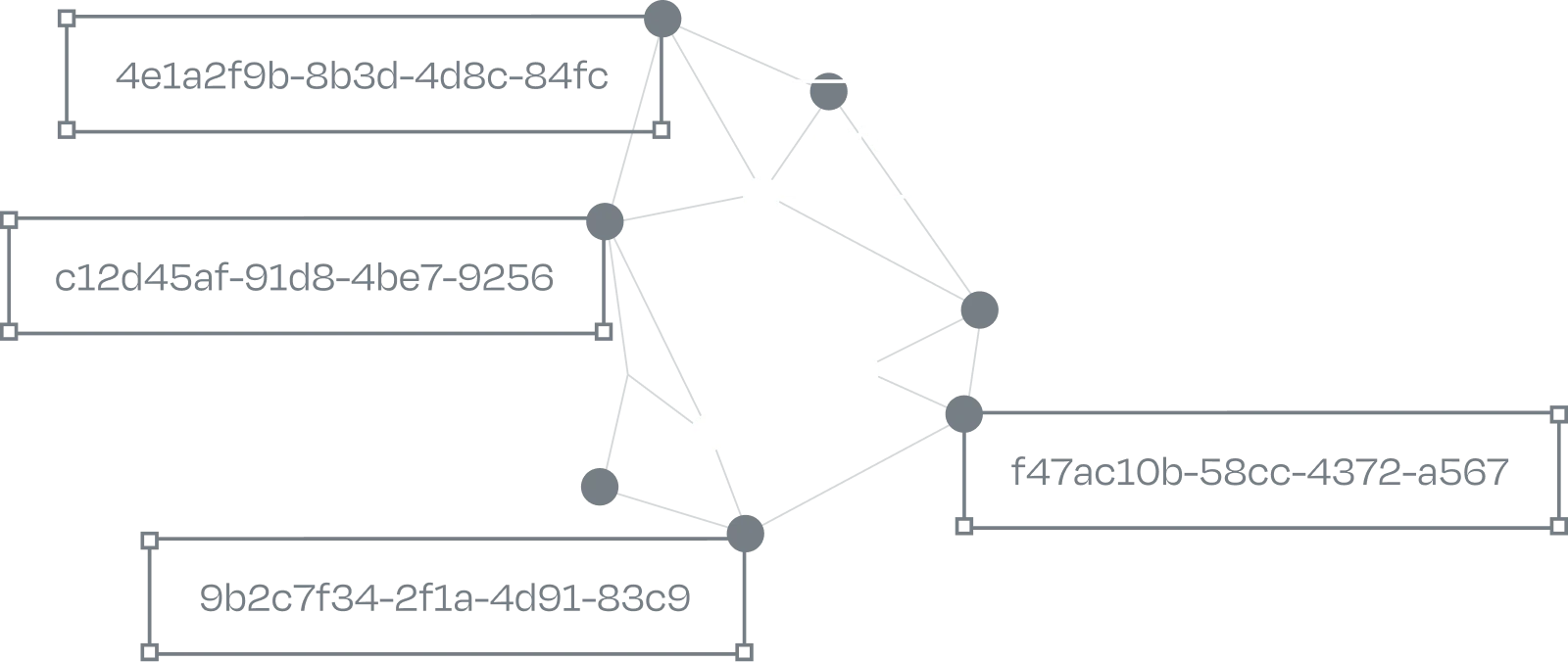
These maps are cryptographically hashed into a secure fingerprint: a unique ID for a physical object.
Triplet structure
At the core of the system are geometric-spectral triplets: small clusters of reference points. Each triplet is one of many keys that together authenticate the object.
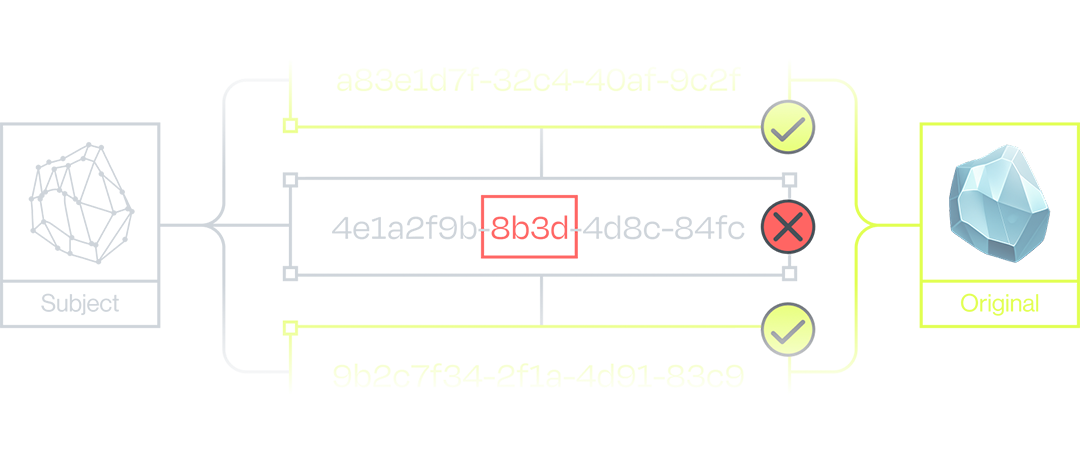
Verification
If an object is cut, modified or partly damaged, enough triplets remain. Comparing them tells Tachyon within seconds whether an item matches the original or has been altered.
From an acquisition perspective
Tachyon's technology combines photogrammetry, 3D scanning and spectral imaging to capture the attributes of real-world objects. Together they go far beyond conventional RGB machine vision.
From a digital twin perspective
Tachyon reconstructs real-world objects in native 3D, combining geometric precision with spectral information to capture both structure and material composition.

High-fidelity digital twin
Tachyon's proprietary reconstruction pipeline gives deterministic, stable processing with micron-level structural accuracy and angstrom-scale sensitivity to the thickness and composition of thin layers, such as photovoltaic films.
Material agnostic
Reconstructs reflective, translucent and transmissive materials without adding anything to the specimen. Traditional systems handle only reflective surfaces, or transparent materials after a coating or index-matching fluid is applied.
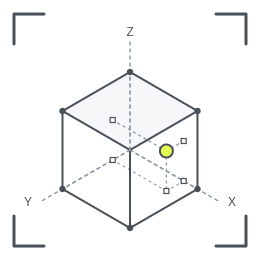
Native 3D
Tachyon identifies an object's characteristics in native 3D, avoiding 2D distortion. It maps exact X, Y and Z coordinates to pinpoint the true depth, volume and position of internal features.
From an algorithmic perspective
Tachyon turns complex physical information into a compact, searchable fingerprint built to survive modification, whether intentional or natural.

Speed
Searches return in under a millisecond, and index building uses GPU acceleration to scale quickly.
Orientation agnostic and resilient to modification
Tachyon's proprietary indexing evaluates every possible orientation and pose at once, and handles partial occlusion. It keeps identifying the object through three kinds of change:
Environmental: wear, UV degradation, weathering and corrosion.
Mechanical: cutting, fragmentation, scratching, compression and expansion.
Man-made alteration: repair, re-polishing, part replacement and restoration.

Security
Records are protected by a quantum-resistant, one-way cryptographic hash. The object's digital identity record is fully masked from company personnel, which protects sensitive details and prevents unauthorised changes to the record.
From a scalability perspective
Tachyon fingerprints, searches and tracks billions of real-world objects with minimal compute, storage and network overhead.

Small storage footprint
Fingerprints range from a few kilobytes to single-digit megabytes, which keeps long-term storage costs low.
Built for global scale
The index is designed to hold billions of unique fingerprints without slowing lookups.

Light network payloads
Efficient queries need few network round trips, so bandwidth costs stay low during enrolment and search.
From an accuracy perspective
Error reduction
Unlike traditional 1:N architectures where scaling introduces lookalike collisions, Tachyon’s architecture False Acceptance Rate (FAR) actually falls as the database expands because spurious micro-feature matches are subjected to exponential database-wide vote dilution.

Accuracy improvement
This systemic dilution of background noise continuously isolates the true match, amplifying the algorithm's signal-to-noise ratio and causing identification accuracy to steadily improve at scale.

Cross-rig consistency
Precise optical alignment means two Tachyon-built rigs scanning the same specimen give the same output, with no variation or drift introduced by the machine.

The Tachyon Platform and Technology are protected by U.S. Patent Nos. 12,375,261, 12,401,496, 12,580,734, 12,683,762. This notice is provided pursuant to 35 U.S.C. § 287(a) (and applicable international patent marking laws). They are also protected by Patents in Canada, Japan, China, Belgium, Switzerland, Germany, France, United Kingdom, Italy, Monaco, Netherlands, Turkey, Russia, Australia, South Africa and the African Regional Intellectual Property Organization (ARIPO).
See Tachyon prove authenticity in your world.